You are here:
The Warrior Coffee Story
Some students drink coffee to motivate themselves to learn. At Lycoming, coffee is learning.
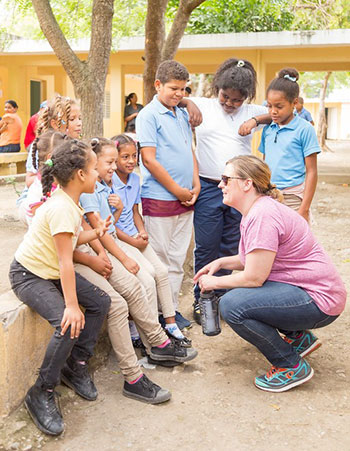
Education faculty member Rachel Hickoff-Cresko talks to school children in Peralta.
Warrior Coffee was born high in the mountains of the Dominican Republic to a political science professor who knew nothing about agriculture. But she knew she wanted to instill her value of service to others in the young scholars she teaches, and journeying to the village of El Naranjito was the first step.
Caroline Payne, Ph.D., associate professor of political science at Lycoming College, founded a connection between Lycoming and the coffee farming community of El Naranjito in the Dominican Republic in 2013. Since then, the ventures on the Caribbean island continue to provide real-world opportunities for political science students to apply what they've learned about socially responsible, sustainable development to help a community in need. Her work emphasizes true service and experiential learning. She is setting up students for careers of social impact and lives of meaning.
Caroline and her team have helped the people in the El Naranjito region improve their farming practices by working together to combat the effects of the Roya fungus that devastates coffee trees, helping diversify the shade canopy to create a better growing environment for coffee and also provide alternative income streams, providing education about growing, harvesting, and processing methods needed to produce specialty grade coffee, and most recently creating a microlending fund to help underresourced producers make the necessary investments to achieve specialty grade quality coffee. By improving the coffee quality and providing farmers with an American market, coffee that previously sold for $.08 per pound now commands $4.66 per pound.
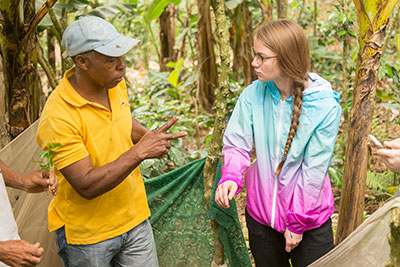
Fellow Brittney Gross '18 converses with a coffee farmer.
Meticulous research and sheer determination led the team to the most responsible method of buying the coffee from the farm, through a producer association — to ensure a fair price — and then exporting it out of the Dominican Republic. An importer brings the coffee into the United States, and moves it on to Sweetspire Coffee & Bakery, adjacent to the Lycoming campus in Williamsport, Pa. Not only does Sweetspire serve and sell Warrior coffees at their own coffee bar, they also package the coffee to sell at the campus store and other local retail outlets like Gustonian Gifts. In addition, green coffee roasters from across the country have purchased beans through Lycoming College, including runner-up on Season 11 of Food Network Star and entrepreneur Jay Ducote, who formerly worked with Baton Rouge-based Cafeciteaux Coffee Roasters to roast and sell the beans under his "JayD's" label. And every day, the Lycoming campus drinks the very coffee produced by the Warrior Coffee project — coffee that it paid a fair price for.
Since its inception, the program has evolved to integrate with other academic departments on campus: Lycoming chemistry students travel to El Naranjito with Jeremy Ramsey, Ph.D., assistant professor of chemistry, to help improve villagers' access to clean water and to analyze the chemical composition of green coffee. Under the leadership of Rachel Hickoff-Cresko, Ed.D., assistant professor of education, students pursuing education certification visit schools in the Dominican Republic to advise instructors on teaching methods. Energy students work with a Lycoming-supported local entrepreneur to provide access to affordable solar technology, which brings power to the remote coffee growers' homes. Other academic departments have also called upon their students to join the Warrior Coffee project, and young scholars focusing on international studies, Spanish, history, creative writing, psychology, anthropology and sociology have already taken part in these interdisciplinary experiences.
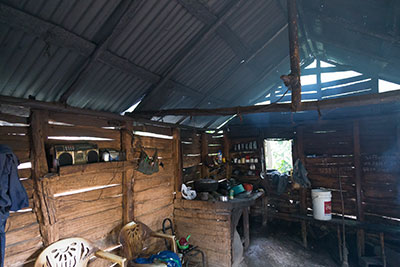
The house where the Ramirez family prepares meals.
At Lycoming, experiential learning is different. The Warrior Coffee project isn't a week-long scheme that ends when students head to the airport. Our students collaborate with the El Naranjito community to identify and solve problems. And our collective, sustained efforts create an impact that is lasting — for the farmers and for our students.
A lot of college classes talk about problems in the world. We help fix them.
Fighting for what's right. One cup at a time.
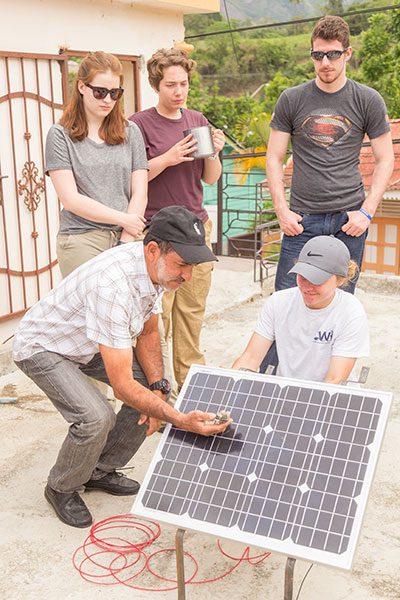
Solar entrepreneur Teofilo instructs Politics of Energy students on installing a solar panel. Cayla Treaster ’19, Mikayla Schappert ’20, Paige Rockwell ’19, and Caleb Herrin ’21.
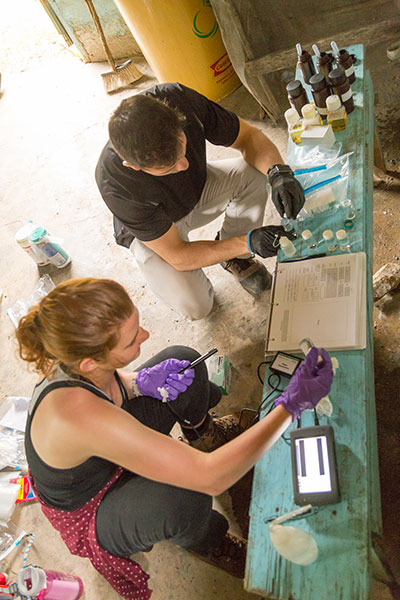
Elizabeth Ritter ’18 & Brandon Conrad ’18 perform tests on water samples in El Naranjito.