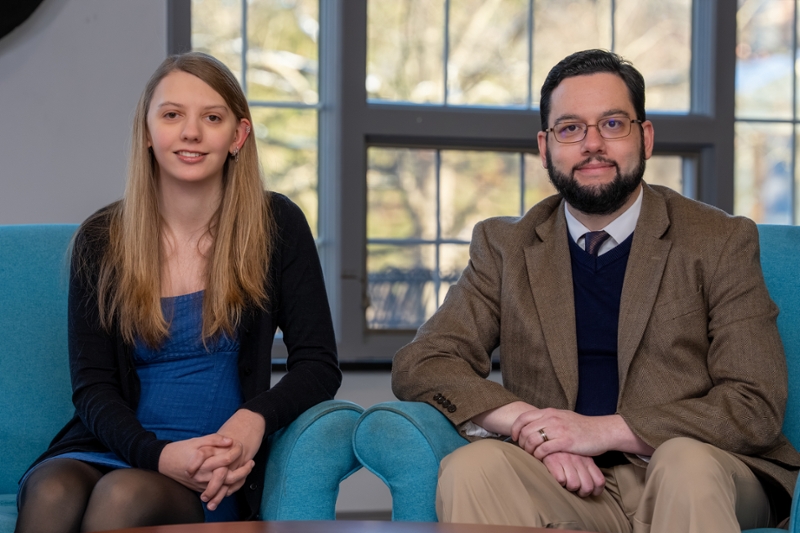
(l-r) Geer, Kantack
Download Image: Web
A study entitled, “What’s in a name? Democrat Party as multivocal communication,” co-authored by Benjamin Kantack, Ph.D., assistant professor of political science at Lycoming College; Kylee Britzman, Ph.D., associate professor of political science at Lewis-Clark State College; and Lycoming political science major Deanna Geer ’27, delves into code words used by politicians. The study was published by Party Politics with a print version due out this year.
Hidden within the polarized and heated rhetoric that dominate American politics today are secret codes for those who know what to look and listen for. Co-authors Kantack, Britzman, and Geer delved into one of these codes — the use of “Democrat Party” rather than “Democratic Party” — and explored what this subtle shift in language says about the politicians who invoke it. From the Red Scare of the 1950s through the Tea Party wave of the 2010s all the way to today, the enduring presence of “Democrat Party” in American political speech reveals a surprising amount about ideology, partisanship, and strategic political communication in the United States.
- Analyzing congressional floor speeches, committee meetings, media reports, and electronic newsletters, the research demonstrates that “Democrat Party” usage by Republican members of Congress is positively correlated with conservatism.
- The work further shows that congressional Republicans are likelier to use the term when in the minority in their chamber and when addressing an external audience.
- The findings are consistent with the co-authors’ theory that “Democrat Party” functions as a form of multivocal communication, invoked by conservative Republicans to subtly signal their ideology to likeminded constituents.
“Politicians are the ultimate strategic communicators, and there's a lot more to the words they use than their literal meaning. ‘Democrat Party’ is unique in American political rhetoric for its longevity and flexibility, which makes it ideal for tracking partisan animosity over time,” said Kantack. “With this project, we show how to leverage it both as a general indicator of polarization in American politics and as a specific marker of the ideology of individual members of Congress.”
“While working on this study with Dr. Kantack and Dr. Britzman, I collected data on the use of the term “Democrat Party” by Congress members through Nexis Uni,” said Geer. “Doing this research has given me experience in how research and data are collected, which I believe will aid me as I move forward into classes such as ‘Research Methods’ and ‘Applied Legal Research and Writing.’ This opportunity also helped me understand the work and time it takes to create a published paper, such as the ones many college students cite in their own papers.”
Lycoming College’s political science department provides an education in the overarching complexities of political values, institutions, processes, and policies. More information on Lycoming’s political science program is available at https://www.lycoming.edu/political-science/.