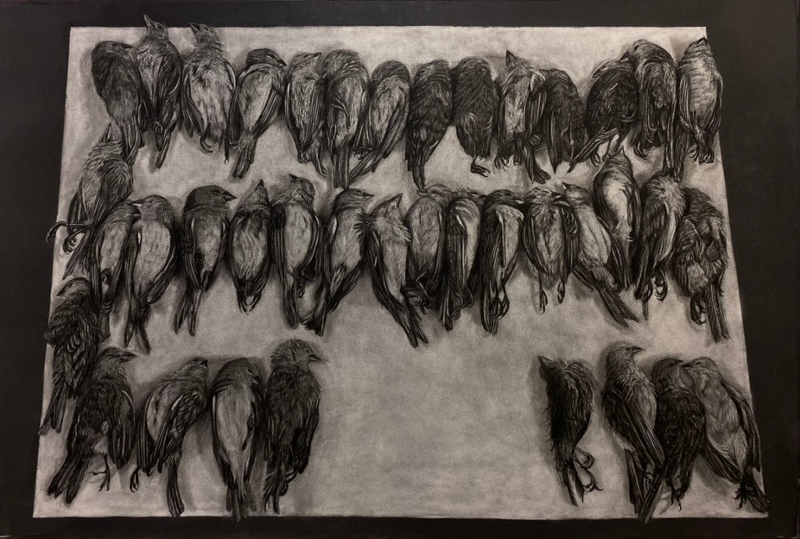
Canaries
Download Image: Web
Title of Exhibit: “All actions have a past and a future”
Exhibit dates: Friday, Feb. 6-Saturday, March 28
Gallery Reception with Artist: Friday, March 20, 5 p.m.
Note: For this public reception, the artist will be in conversation with Marisa C. Sánchez, Ph.D., assistant professor of art history and curator of the exhibit
In-residence at Lycoming College: March 16-20
Public Artist Talk titled “Quantum Curiosity:” Tuesday, March 17, 4:30 p.m. in Trogner Presentation Room, Krapf Gateway Center, Lycoming College
Note: Elder’s talk is part of the Environmental Justice Symposium
https://www.lycoming.edu/news/stories/2026/01/environmental-justice-symposium.aspx
Artist, researcher, and visual storyteller, Nina Elder (b. 1981) has been invited to be an Artist-in-Residence at Lycoming College during spring semester 2026.
Elder’s residency includes a solo exhibit at the Lycoming College Art Gallery that will bring together two video works “Overburden” and “Tongue Stones” and thirteen drawings from two series, “Uplift” and “Timepieces”. These intricate drawings reveal the artist’s conceptually oriented material practice that addresses natural resources and extractive industries expressed through her use of site-specific pigments, including coal and wildfire charcoal, industrial pulp mill waste, marine motor lubricant, glacial silt, and stardust. Elder’s work invites viewers to contemplate our environmental impact, observing: “We are interfering with geologic time and geologic process, and I don’t know if the earth will heal from what we have done to it.” She continued, “I believe we can take actions now that mean we will be ancestors to a better future.”
“[t]he power of art is to help us learn the future that we want to bring into being. It helps us envision the unforeseeable and the unthinkable and reflect on the current moment with great potency to understand what the future might look like.” (Nina Elder)
The artist’s drawings are often based on historic and sometimes classified photographs as well as those resulting from her own fieldwork. Reflecting on her practice, the artist noted an interest in exploring moments “when the human hand comes in contact with the natural world and potentially changes an individual and the economy in a place forever.”
With a focus on changing cultures and ecologies, Elder advocates for collaboration, fostering relationships between institutions, artists, scientists, and diverse communities. Her work takes many forms, including drawings, performative lectures, pedagogy and critical writing, long-term community-based projects, and public art. At Lycoming College Art Gallery, Elder’s exhibit will include a “learning lab” for hands-on creative engagement that aims to stimulate curiosity, reflection, and dialogue. The “learning lab” will be a meeting place to share ideas and learn together, encouraging visitors to the gallery to explore connections with the themes and ideas explored through the artist’s work on view.
In Elder’s drawing series “Uplift,” the artist explores the mechanisms of industrial lifting with those of carrying emotional burdens or “the kinds of invisible emotional lifting we all do,” as the artist has stated. In “Timepieces,” a series of seven, subtly emotive drawings, the artist explores how “Time is understood through an array of measures - seasons, moods, migrations, and lifelines” and proposes we consider “a constellation of alternative clocks and calendars.” In “Mercury (the mortal interlocutor)” (2022) and “Canaries” (2022) both made using wildfire charcoal and graphite on paper, the artist depicts an inauspicious world. In “Mercury (the mortal interlocutor)”, the artist portrays the planet Mercury as sublime, hovering within an empty, vast space of darkness. In “Canaries”, as Sánchez proposes in her reading of this melancholic drawing: “Elder’s sensitive depiction of more than thirty dead canaries poignantly signals both vulnerability of species and a warning of environmental distress and ecological concern that calls into question the very conditions of the air we breathe.”
Additionally, her two video works on view include “Overburden” and “Tongue Stones,” the later of which depicts the artist's futile attempt to gain intimacy, knowledge, and empathy with geologic materials by forcing them into her mouth. Filmed at the edge of a receding glacier in Alaska, this performance documented on video is an inquiry into displaced and disregarded materials. In “Tongue Stones,” the artist embodies and implicates herself in the legacies of disruption, extraction, and neglect that shape the American Western landscape. By stretching herself beyond capacity, she manifests the exploitation and voracity that emboldens capitalism, and the overburdening that creates trauma in human and ecological bodies.
Elder believes “[t]he power of art is to help us learn the future that we want to bring into being. It helps us envision the unforeseeable and the unthinkable and reflect on the current moment with great potency to understand what the future might look like.”
As Sánchez began to curate Elder’s work for the gallery, in dialogue with the artist, the content of her drawings and videos led to conversations between Sánchez and Phoebe Wagner, Ph.D., assistant professor of English, who collaborated to realize an interdisciplinary Environmental Justice Symposium at the College this spring semester. Elder’s exhibit and residency are part of this symposium, which includes public talks that will empower students and faculty to consider environmental impact on their communities and the power of art and storytelling to support environmental justice movements.
During Elder’s residency, which takes place March 16-20, Elder will be on campus and at the Lycoming College Art Gallery to collaborate with students and faculty. She will offer several facilitated workshops within the “Learning Lab” at the Gallery for students and faculty, including those in Art + Environment seminar (Sanchez); Worldbuilding (Wagner); Environmental Literature (Wagner); and Drawing II (Howard Tran), among others.
More About the Artist
As an artist and researcher, Elder creates projects that reveal humanity’s dependence on, and interruption of, the natural world. She is also devoted to rural communities and often overlooked places; she regularly works outside of urban cultural centers and the commercial art world. Elder lectures as a visiting artist/scholar at universities, develops publicly engaged programs, and consults with organizations that seek to grow through interdisciplinary programming.
Recent solo exhibitions of Elder’s art have been organized by University of Colorado, SITE Santa Fe, Utah Museum of Contemporary Art, and museums across the United States. Her work has been featured in Art in America, VICE Magazine, Hyperallergic, and on PBS. Elder’s writing has been published by Dark Mountain, Routledge Press, and American Scientist, among others, and her research has been supported by the NEA, the Warhol Foundation, Rauschenberg Foundation, Pollock-Krasner Foundation, and Mellon Foundation. When she is not traveling for research, exhibitions, and teaching, Elder lives off the grid in Colorado.
Elder holds an M.F.A. in painting from the San Francisco Art Institute and a B.F.A. in painting from the University of New Mexico. More about Elder can be found online at https://www.ninaelder.com/studio-response.
About the Lycoming College Art Gallery
The Lycoming College Art Gallery, located in downtown Williamsport at 25 W. Fourth St., contributes to the city’s arts culture and enables the College to become more involved with the surrounding community. Lycoming art students have the opportunity to interact with visiting artists and learn first-hand the inner workings of an art gallery.
The gallery is open Thursdays, Fridays, and Saturdays from 4-8 p.m. For more information, please visit the gallery online.
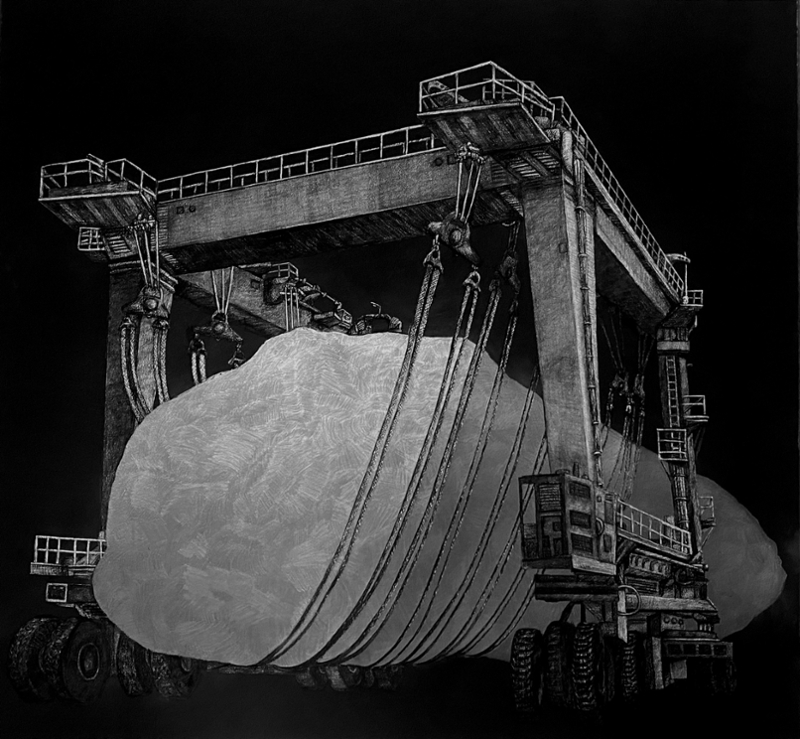
Cradle
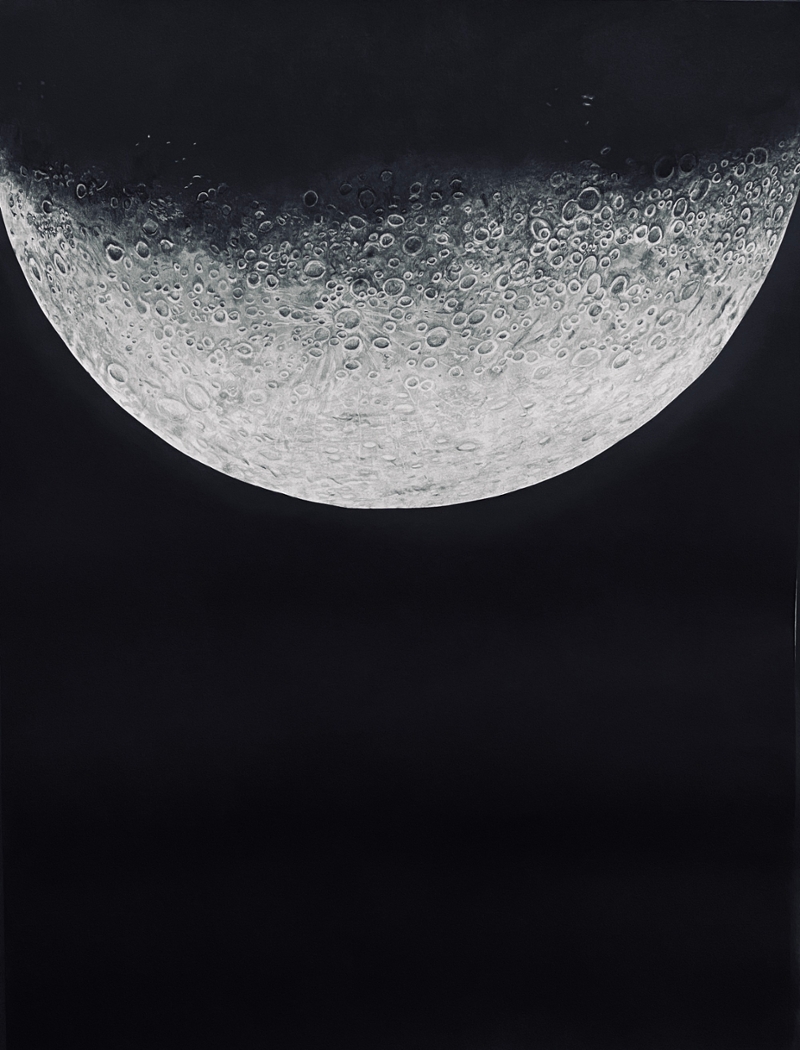
Mercury
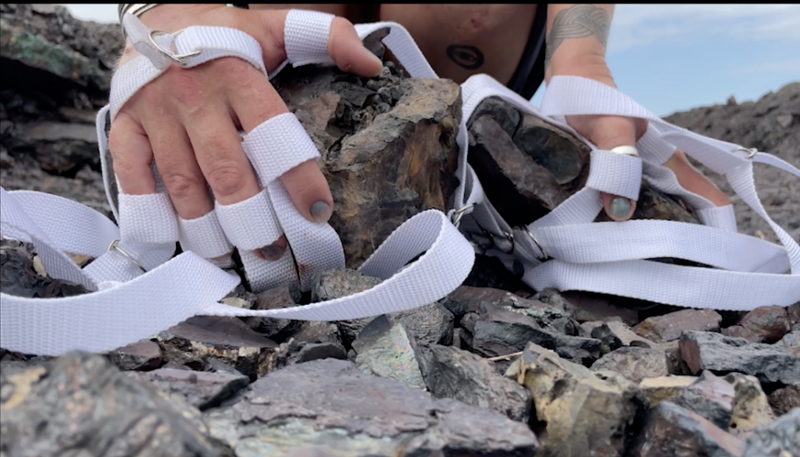
Screenshot: Overburden
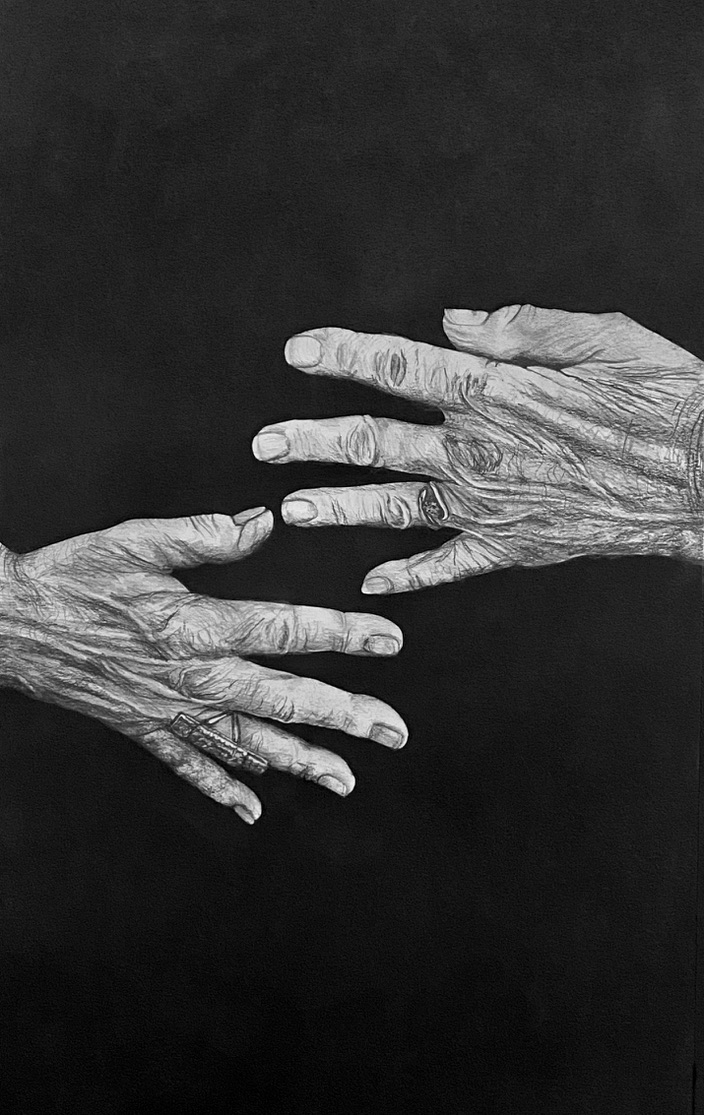
Mom's Hands