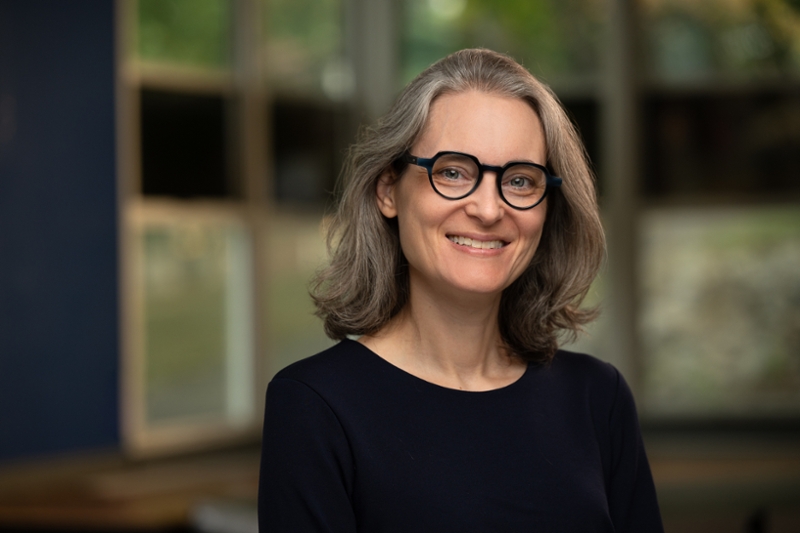
Download Image: Web
Lycoming College will host art historian Tanya Sheehan, Ph.D., for a talk titled “Communities of Care: Jacob Lawrence and the Murals of Harlem Hospital,” on Wednesday, Oct. 21, at 7:30 p.m., in the Trogner Presentation Room in Krapf Gateway Center. The event is free and open to the public with a reception to follow.
In the late 1930s, as federally funded artists painted large-scale murals at Harlem Hospital, a young Jacob Lawrence was painting scenes of the same institution. Sheehan's talk examines those connections, tracing how Black life could be represented on the walls of Harlem's largest public healthcare facility, and how Lawrence’s art expresses ideas about care within Black communities.
"Bringing together art history, medicine, and the lived experience of Black communities in the mid-twentieth century in the predominately Black neighborhood of Harlem, Sheehan’s talk will show our students how a painting can carry a whole social history."
The talk connects directly to several courses on campus, including African American History, led by Sarah Silkey, Ph.D., professor of history; Race and Ethnicity in U.S.-American Art, taught by Marisa Sánchez, Ph.D., assistant professor of art history; and Health Professions with David Andrew, Ph.D., assistant professor of biology. Dr. Sheehan will visit these classes and facilitate tailored discussions. With Andrew’s students, she will explore the intersection of visual art and medical humanities, and in Silkey’s and Sánchez’s seminars, she will advance conversations on the Harlem Renaissance, with a focus on artist Aaron Douglas, whose paintings offer empowered representations of the experiences of African Americans in the United States at that time.
“A leading scholar in the field of American art, Sheehan will center in her lecture African American artist Jacob Lawrence to introduce her ongoing research project that explores the racial politics of American medicine and public health during the 1930s,” said Sánchez. “Bringing together art history, medicine, and the lived experience of Black communities in the mid-twentieth century in the predominately Black neighborhood of Harlem, Sheehan’s talk will show our students how a painting can carry a whole social history.”
Sheehan is the James M. Gillespie Professor and chair of the department of science, technology, and society at Colby College, and director of academic and scholarly engagement at the Lunder Institute for American Art at the Colby College Museum of Art in Waterville, Maine. From 2021 to 2024, she was the principal investigator of Colby’s first Public Humanistic Inquiry Lab devoted to critical perspectives on medicine and race. Previously, as Ellerton M. and Edith K. Jetté Professor of Art, she chaired the departments of art and American studies. She has twice held the position of special advisor to the provost, a role through which she led the development of new interdisciplinary academic programs at Colby and co-designed the Colby’s environmental humanities initiative funded by a grant from the Andrew W. Mellon Foundation.
From 2015 to 2025, Sheehan served as executive editor of the Smithsonian Institution’s Archives of American Art Journal, the longest-running publication devoted to the study of American art and its histories. Last year she held two residential research fellowships, one at Clark Art Institute in Williamstown, Mass., and the other at Crystal Bridges Museum of Art in Bentonville, Ark. She is currently a senior fellow at the Smithsonian American Art Museum, completing a book on medicine and public health in art by African Americans, which is forthcoming from Yale University Press. Among her previous publications are five edited volumes, two exhibition catalogues, and two single-authored books, “Doctored: The Medicine of Photography in Nineteenth-Century America” (2011) and “Study in Black and White: Photography, Race, Humor” (2018). In 2018, she was awarded the prestigious Terra Foundation for American Art International Publication Grant for “Study in Black and White,” which shows how photographic humor was used in the United States and across the British empire to express evolving ideas about race, Black emancipation, and civil rights.
James and Emily Douthat Distinguished Lectureship
The lecture is sponsored by the James and Emily Douthat Distinguished Lectureship Series in the liberal arts and sciences, named for James Douthat, former president of Lycoming College, and his wife Emily, for their years of service to the College. The annual lecture, which is not field-specific, attracts top scholarly guest speakers to the College and has featured Nobel Prize and Pulitzer Prize winners. Lycoming’s chapter of Phi Kappa Phi, a national honor society for all academic disciplines, organizes the lectureship.